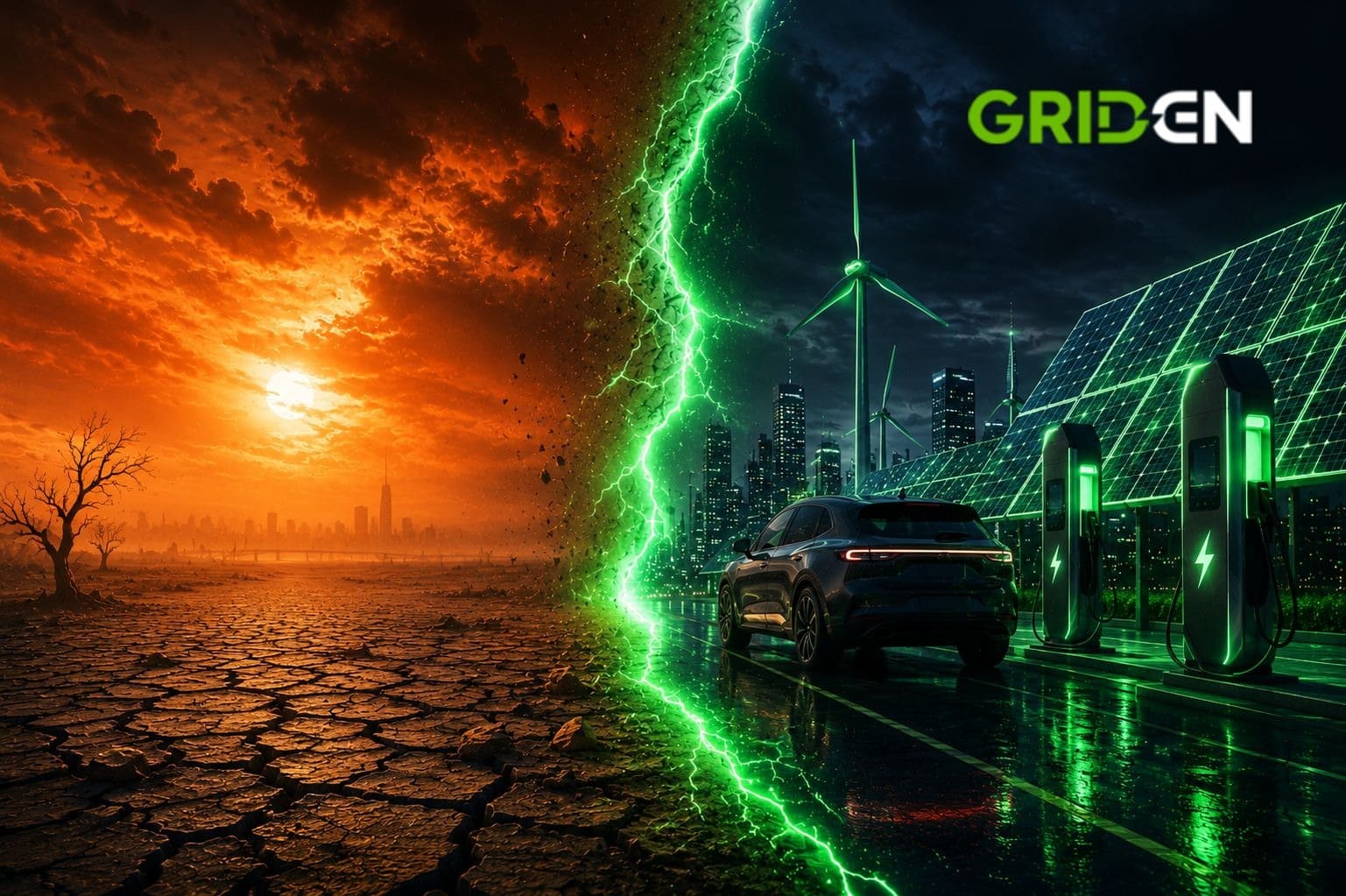
Every time fuel prices spike, the same conversation starts. Emergency cabinet meetings. Panic at the petrol pump. Headlines about crude oil crossing another threshold. Meanwhile, the actual crisis keeps building quietly in the background.
Fuel prices rise and fall. Climate change does not. India and the world are staring at the wrong problem. The real energy challenge has never been about the cost of oil. It is about what happens when the planet itself starts working against you. And in 2026, El Nino is delivering that lesson in real time.
We Keep Misreading the Energy Problem
Ask ten business leaders about India's biggest energy challenge and most will say: fuel import costs, supply chain exposure, or grid reliability.
Those problems are real. They deserve serious attention. But they are symptoms. The underlying condition is climate change. Climate change is silently restructuring how energy works. It is shifting where water flows. It is lengthening heatwaves. It is making the monsoon less predictable each year. It is raising the baseline cost of keeping a country cool, fed, and powered.
Talking about energy security without addressing climate is like treating a recurring fever with painkillers. You manage the discomfort. The infection keeps spreading.
Here is what is happening right now. A historic Super El Nino is forming in the Pacific Ocean. NOAA, the United States' foremost climate agency, puts the probability of full El Nino conditions between August and October 2026 at over 90 percent. Scientists are comparing its potential scale to the 1876-78 event, one of the deadliest climate disasters ever recorded.
This is not a scenario. It is in motion.
What Does El Nino Actually Do?
El Nino is not simply bad weather. It is a fundamental shift in the Pacific Ocean's heat distribution that rewires weather systems across the entire planet.
Under normal conditions, trade winds push warm surface water westward toward Asia. Cold, nutrient-rich water rises near South America. The system holds a working balance.
During El Nino, those trade winds weaken. Warm water moves east. The atmospheric engine changes rhythm. The results are predictable in type but extreme in scale: floods in some regions, severe drought in others, heatwaves that stretch weeks longer than usual, and monsoons that show up late, leave early, or stall entirely over the wrong geography.
For India, the stakes are high and direct.
Nearly half of India's cultivated land depends on rainfall. Reservoirs, groundwater tables, hydropower output -- all of it is downstream of the monsoon. El Nino weakens that monsoon. Not every time, not uniformly, but consistently enough to cause serious damage when it hits hard.
The 2026 event is already tracking above 2 degrees Celsius above long-term sea surface averages. A standard El Nino begins at just 0.5 degrees. What is developing now is at least four times the normal threshold.
A December 2025 study in the journal Nature Communications identified another risk layer: Super El Nino events can trigger Climate Regime Shifts. These are sudden, long-lasting changes to the climate system that do not self-correct. Regions with historically reliable rainfall can shift permanently to drier baselines. Soil moisture, water availability, and agricultural yields can stay disrupted for decades.
That is not a future projection. It is a documented pattern from past events, now amplified by a warmer baseline ocean.
El Nino Reveals What Environmental Imbalance Actually Costs
When we burn fossil fuels and push atmospheric greenhouse gas concentrations higher, we do not simply make the world a few degrees warmer. We feed additional energy into climate systems that were never calibrated for it.
El Nino already releases enormous volumes of Pacific Ocean heat into the atmosphere on a natural cycle. That alone creates significant disruption. Now stack human-driven warming on top of a natural El Nino event, and the interaction becomes something different: amplified, harder to predict, and far more costly to manage.
The 1997-98 El Nino caused widespread coral bleaching, severe droughts across South Asia, and lasting damage to fisheries and agriculture. The 2015-16 event set a new global temperature record. Scientists now project the 2026 event could break that record again, potentially making 2027 the hottest year in recorded history.
The energy consequences follow a direct chain.
Longer heatwaves drive air conditioning demand through the roof. Millions of households simultaneously pull power. Grids strain. In some regions, they fail.
At the same time, weak monsoons lower reservoir levels. Hydropower output drops. India fills that gap with thermal power. Thermal power burns coal. Coal releases carbon dioxide. Carbon dioxide raises temperatures further. The cycle tightens with each pass.
This is not a vicious cycle in the abstract sense. It is a compounding liability that grows with every year of delayed action.
Energy Security and Climate Are Now the Same Conversation
The clean energy transition used to be framed primarily as a climate goal. That framing has shifted.
Energy security is now the dominant driver, and for good reason.
Conflicts in West Asia are keeping the Strait of Hormuz under pressure. That single waterway carries a substantial share of the world's oil supply. When it is threatened, countries that depend on imported fuel are exposed to disruptions they cannot control, predict, or hedge against locally.
Solar panels, wind capacity, and battery storage solve a different problem than reducing emissions. They solve the problem of dependency. A solar installation in Rajasthan does not care about shipping lanes in the Persian Gulf. It produces power regardless of what happens in Hormuz.
India has built real momentum here. Renewable capacity is growing. Solar manufacturing is scaling up domestically. But the pace needs to match what 2026 is asking of the country.
The urgency is not being set by policy targets. It is being set by what is happening in the Pacific right now.
What 2026 El Nino Means for India Specifically?
India's exposure to El Nino is not abstract.
The southwest monsoon underpins the entire economy. It fills reservoirs, irrigates crops, generates hydropower, and moderates food inflation. When the monsoon weakens, the effects touch every household in the country, whether in a farming district or a city.
The 2026 Super El Nino creates four overlapping pressure points:
Agriculture
Below-normal Kharif season rainfall reduces rice, pulses, and sugarcane output. Food prices go up. Maharashtra, Karnataka, and Madhya Pradesh face the highest exposure due to delayed monsoon onset and extended heat stress.
Water
India's groundwater is already under serious strain. A weak monsoon makes natural recharge harder. Concentrated rainfall events -- where a season's worth of rain falls over a few days -- make it difficult to capture and store water before it runs off.
Energy demand
Heatwaves push electricity demand up sharply. Weak monsoons push hydropower output down. Both happen at the same time. The grid faces maximum pressure exactly when it has the least capacity to absorb it.
Food inflation
Reduced agricultural yields translate directly into higher food prices. For millions of Indian households, this is not an economic data point. It is a lived constraint on monthly budgets.
Prof J Srinivasan from IISc's Divecha Centre for Climate Change made the point clearly: "We managed well during the 2015 El Nino, but there was no war at that time." The 2026 situation layers climate risk onto active geopolitical risk in a way India has not faced before. The margin for error is smaller.
Climate Change Is Happening Now. Not Later.
For years, climate conversations were built around future scenarios. "By 2050, if current trends continue..." "The next generation will inherit..." That framing has expired.
El Nino 2026 is not a projection. It is an active weather system. The warming amplifying it is not a forecast. It is a measured fact. The effects on India's monsoon, agriculture, power grid, and economy are not hypothetical. They are already showing up in IMD forecasts, commodity markets, and energy planning models.
Climate change is the defining condition of the present. Not the future. Every business, every infrastructure project, every energy policy that treats climate as a long-range concern is being planned against the wrong timeline.
What India Needs to Do Now?
The solutions are not complicated. They are well understood. What is missing is the pace of execution.
Speed up renewable energy deployment
Solar and wind are now among the cheapest electricity sources in India. Each megawatt of renewable capacity built reduces both fossil fuel dependency and long-term carbon exposure. India cannot afford to slow this down.
Build water infrastructure for a volatile monsoon
Rainwater harvesting, groundwater recharge programs, and better reservoir operations are not optional investments. In an El Nino year, they are front-line infrastructure. India receives substantial annual rainfall. The problem is capturing it before it runs off.
Make agriculture climate-resilient
Drought-resistant crop varieties, diversified cropping patterns, and improved irrigation planning reduce the damage a weak monsoon can cause. These are not new ideas. They need wider implementation and faster funding.
Map climate risk at the local level
Heatwave vulnerability, agricultural sensitivity, infrastructure exposure, and energy supply risk need to be mapped at the district and taluka level. Crisis management is expensive and reactive. Risk mapping makes preparation possible.
Integrate energy and climate policy
These are not separate conversations. Every energy investment is a climate decision. Every climate event creates an energy consequence. Policy that treats them separately will keep arriving at the wrong answers.
Conclusion
India's biggest energy challenge is not what happens at the petrol pump. It is what happens when the ocean warms, the monsoon underperforms, reservoirs drop, crops fail, and heatwave-driven electricity demand exceeds what the grid can supply. All at the same time.
El Nino in 2026 is showing us the real cost of letting environmental imbalance accumulate. It is not a warning about the future. It is an invoice from the present.
Countries that grasp this clearly and act on it will be better positioned than those still waiting for oil prices to stabilize before taking climate seriously. India has the science, the renewable infrastructure momentum, and the scale to lead this transition. Every EV charging station manufacturer stepping up today, every solar installation commissioned, and every grid upgrade completed is a direct investment in that resilience. What is needed now is an urgency that matches the reality on the ground. El Nino is not waiting. Neither can we.
Frequently Asked Questions
What is the biggest energy challenge in India today?
The biggest energy challenge is not fuel price volatility. It is climate change. Longer heatwaves, irregular monsoons, and extreme weather directly disrupt power generation, spike electricity demand, and strain grid infrastructure. For a country that depends on hydropower and monsoon-fed agriculture, the climate is the energy variable that matters most.
What is El Nino and why does it affect India?
El Nino occurs when Pacific Ocean surface temperatures rise significantly above normal, disrupting weather systems globally. For India, it weakens the southwest monsoon, reduces overall rainfall, and increases the risk of drought, heatwaves, and water scarcity. These effects flow directly into agriculture, hydropower output, food prices, and rural livelihoods.
How dangerous is the 2026 El Nino?
Scientists warn the 2026 El Nino could qualify as a Super El Nino, with sea surface temperatures exceeding 2 degrees Celsius above the long-term average. NOAA puts the probability of El Nino persisting through late 2026 and into 2027 at above 63 percent. Researchers are comparing its potential intensity to events that have historically caused severe drought, crop failure, and energy disruption across South Asia.
How does climate change affect energy security?
Climate change makes energy supply less reliable and more expensive to maintain. Heatwaves increase electricity demand. Droughts cut hydropower generation. Extreme weather damages transmission infrastructure. The longer-term solution is renewable energy, which reduces carbon output and eliminates dependence on fossil fuel markets that are vulnerable to geopolitical disruption.
What should India do to prepare for El Nino impacts?
India needs faster renewable energy deployment, improved water harvesting and groundwater recharge programs, climate-resilient agricultural practices, and district-level risk mapping for heatwaves and monsoon variability. Policy preparation based on early warning data is significantly more effective than reactive crisis management after damage occurs.

