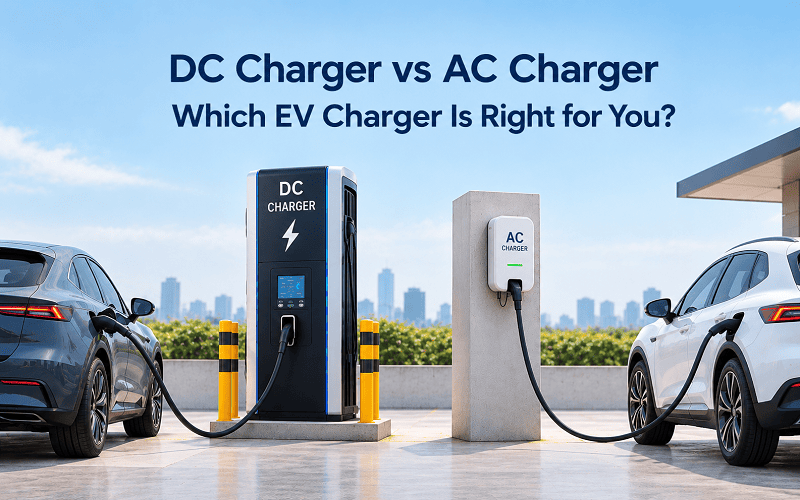
Slow charger or fast charger? Ask a homeowner in Pune, a hotel owner in Udaipur and a fleet manager in Delhi, and you'll get three different answers.
They're all right. The best EV charger depends on how long your vehicle stays parked, what your EV can actually accept and how much power your location can support.
This guide compares DC fast chargers and AC chargers in plain language, with Indian examples, so you can decide what suits your home, business or charging station.
What Is an AC EV Charger?
An AC EV charger supplies alternating current (AC), the same power that runs appliances at home. A battery stores only direct current (DC), so the power must be converted. In AC charging, this happens inside the vehicle, in the onboard charger. The AC charger itself is a safe connection point that communicates with the vehicle and then lets power flow.
Why AC charging is generally slower: The vehicle accepts only as much power as its onboard charger can handle, even if the charger can supply more. Onboard chargers are compact to fit inside the car.
Where AC chargers are commonly used:
- Homes and garages
- Apartment complexes
- Offices and workplaces
- Hotels and resorts
- Malls and multiplex parking
- Airport and railway station parking
In these places, vehicles sit for hours anyway, so a steady, moderate charge is usually enough. When buying, it helps to work with a reliable AC charger manufacturer in India that supports the connectors and protocols your vehicles use.
What Is a DC Fast Charger?
A DC fast charger supplies direct current (DC) straight to the battery. The AC-to-DC conversion happens inside the charger, not the car. Being large and purpose-built, with its own cooling and power electronics, it can handle much higher power than an onboard charger. This is why an EV fast charger in India is commonly placed where drivers have limited time, such as highways and busy commercial hubs.
Why DC charging suits quick charging: The vehicle's battery management system (BMS) tells the charger how much power the battery can safely accept, and the charger adjusts. Power flows fast when it is safe and reduces when it is not.
Where DC fast chargers are commonly used:
- Highways and expressways
- Fuel stations
- City charging hubs
- High-footfall commercial locations
- Fleet depots
- Dealerships (delivery readiness, demo vehicles)
AC vs DC Charging: How Do They Work?
Follow the electricity:
- AC charging: Grid → AC charger → EV's onboard charger (converts AC to DC) → Battery
- DC fast charging: Grid → DC charging equipment (converts AC to DC) → Battery
The grid supplies AC in both cases. The only difference is where the conversion happens.
Why it matters: Think of filling a tank through a narrow pipe versus a wide one. In AC charging, the onboard charger is the narrow pipe and sets the upper limit. In DC charging, that pipe is bypassed, so the battery can take power much faster, limited mainly by what it can safely accept.
A note on connectors in India:
- Four-wheelers: Commonly use Type 2 for AC and CCS2 for DC, though models can differ. Check your vehicle manual.
- Two and three-wheelers: Often use lighter-duty arrangements, and some have their own standards.
- Always match the charger's connector and communication protocol to the vehicles you plan to serve.
DC Fast Charger vs AC Charger: Detailed Comparison
Figures are general indications. Actual performance depends on the EV's battery capacity, onboard charger, charging capability, state of charge, temperature, charger rating and other vehicle-specific factors.
| Factor | AC Charger | DC Fast Charger |
|---|---|---|
| Type of current delivered | AC to the vehicle | DC straight to the battery |
| Power conversion | Inside the vehicle (onboard charger) | Inside the charger |
| Charging speed | Moderate; limited by onboard charger and supply | Much higher; limited mainly by battery and charger capability |
| Typical charging duration | Often several hours for a substantial charge | Often tens of minutes for a substantial top-up |
| Common charging locations | Homes, apartments, offices, hotels, malls | Highways, fuel stations, charging hubs, fleet depots |
| Ideal usage | Daily, planned charging while parked | Quick top-ups, en-route charging, rapid turnaround |
| Vehicle compatibility | Most EVs; rate depends on the vehicle | Only EVs with DC charging and a matching connector |
| Infrastructure requirement | Relatively simple; standard protection and earthing | More involved; dedicated supply, cooling, often a transformer upgrade |
| Power requirement | Lower; single- or three-phase | Significantly higher; usually three-phase |
| Space requirement | Compact; fits in parking bays | Larger footprint; needs room for equipment and vehicle movement |
| Best suited for | Vehicles parked for hours | Vehicles that stop briefly and must leave quickly |
| Typical Indian use cases | Housing societies, offices, hotels, malls, campuses | Expressway plazas, highway fuel stops, cab and fleet hubs, dealership delivery bays |
Why Is DC Fast Charging Faster Than AC Charging?
- Onboard charger limit: In AC charging, the car's onboard charger decides how much power gets in.
- Direct delivery: In DC charging, conversion happens outside the car, so there is no bottleneck.
- Higher output: External equipment can deliver far more power, since size, weight and heat are easier to manage.
- BMS in control: The BMS tells the charger how much power the battery can safely take at each moment.
- Charging curve: Speed is highest at a low state of charge and slows as the battery fills. This is why many drivers stop at a moderate level on long trips instead of charging to 100%.
Important: An EV won't always charge at the charger's maximum rating. A 60 kW charger doesn't mean your car will draw 60 kW throughout. The vehicle's limits, battery condition and temperature all play a part.
AC Charging: Where Does It Make More Sense?
AC works best where vehicles stay parked for hours.
- Overnight home charging: Eight to ten hours is usually enough for a day's commute.
- Offices: A car plugged in at 9:30 a.m. has the whole working day to charge.
- Apartments: Long parking durations, and many bays can share one supply.
- Hotels and resorts: Guests can charge while they rest.
- Malls and multiplexes: A movie and a meal can mean three to four hours of parking.
Slowing isn't always a disadvantage. If a car is parked for ten hours anyway, finishing in two hours instead of six makes no real difference. AC also puts a lower, steadier load on the supply.
DC Fast Charging: Where Does It Make More Sense?
DC fast charging is valuable where time is the constraint.
- Highway travel: On a drive like Delhi to Jaipur, a short tea or lunch stop can add useful range, depending on the vehicle.
- City top-ups: Helps a driver who forgot to charge overnight or has an unplanned errand.
- Charging hubs: Fast turnaround means less queueing.
- Fleets: For cabs and delivery vehicles, time spent charging is time not earning.
Why downtime matters: A private car idle overnight costs nothing, but a fleet vehicle waiting to charge mid-shift means fewer completed trips.
AC or DC: Which Is Better for EV Battery Health?
Neither is always better, and DC fast charging isn't harmful by default. Modern EVs have a BMS that controls charging speed, monitors temperature and limits power when needed. Both AC and DC are normal parts of EV use.
Battery ageing depends on:
- Chemistry: LFP and NMC respond differently to charging.
- Temperature: Extreme heat or cold matters, especially during repeated fast charging in India's summers.
- Frequency: How often you do deep cycles and fast sessions.
- State of charge: Regularly sitting at very high or very low levels may influence long-term behaviour.
- Charging power: Higher power creates more heat for the thermal system to manage.
- Vehicle design: BMS and cooling differ between models.
Practical approach: Use AC for routine daily charging when time allows, and DC when you need it, such as on long trips. Follow your manufacturer's recommendations.
How to Choose Between an AC Charger and a DC Fast Charger
Choose AC when:
- The vehicle stays parked for several hours
- Overnight charging is possible
- Charging is mainly for daily use
- You want to serve many vehicles on a limited electrical supply
Consider DC fast charging when:
- Vehicles need quick turnaround
- The location serves highway travellers
- Charging demand is high
- Fleet utilisation and downtime matter
Consider using both when:
- Your location has a mix of long-stay and short-stay users
- Some vehicles need quick top-ups while others can charge slowly
- You expect EV adoption in your area to grow
One question to ask: "How long will the vehicle be here, and how much charge does it need before it leaves?" If the answer is "many hours, and a moderate amount," AC is usually enough. If it is "less than an hour, and a substantial amount," DC becomes more relevant.
Conclusion
AC and DC charging do different jobs. AC is steady and practical where vehicles park for hours: homes, apartments, offices, hotels and malls. DC fast charging is built for places where time is short: highways, busy commercial hubs and fleets that can't afford long downtime.
The right choice comes down to a few questions. How long will the vehicle stay? How much charge does it need? What can the EV accept? What can the electrical supply handle? How might demand grow?
In many cases, the most sensible answer is a mix of both, matched to how people actually use the space. As EV charging infrastructure in India grows, planning around real usage, not headline kW figures, will serve drivers and businesses better.
Frequently Asked Questions
1. Is a DC fast charger better than an AC charger?
Neither is better in every situation. DC suits speed-critical places such as highways and fleets. AC suits places where vehicles stay parked for long, such as homes and offices.
2. Which is faster, AC or DC charging?
DC is generally faster, because power is converted outside the vehicle and delivered directly to the battery. Actual speed still depends on the vehicle, battery state and temperature.
3. Is AC charging better for daily EV charging?
For most people, yes. If your car is parked at home or work for several hours, AC usually provides enough energy for daily needs.
4. Can all EVs use DC fast chargers?
No. Only vehicles with DC charging capability and a compatible connector can. Some two- and three-wheelers support only AC or other arrangements. Check your vehicle manual.
5. Can an EV be charged with both AC and DC?
Most four-wheelers with a DC port can use both. Many have a single combined inlet that accepts either, depending on the vehicle's design.
6. Is DC fast charging safe for EV batteries?
Modern EVs are designed to support it, and the BMS controls power to protect the battery. Long-term behaviour depends on chemistry, temperature and how often you fast charge. Follow the manufacturer's guidance.
7. Which charger is better for highway charging?
DC fast chargers, as travellers usually want to charge quickly and continue their journey.
8. Which charger is better for home charging?
AC. Vehicles are parked for long periods, and a home AC charger is simple, compact and well-matched to daily needs.
9. Should businesses install AC or DC chargers?
It depends on how long vehicles stay and how fast they must leave. Offices and hotels usually suit AC. High-turnover sites and fleets needing rapid turnaround should consider DC.
10. Can a location have both AC and DC chargers?
Yes, and many benefit from it. A mix serves users with different time needs and makes better use of your electrical capacity.

