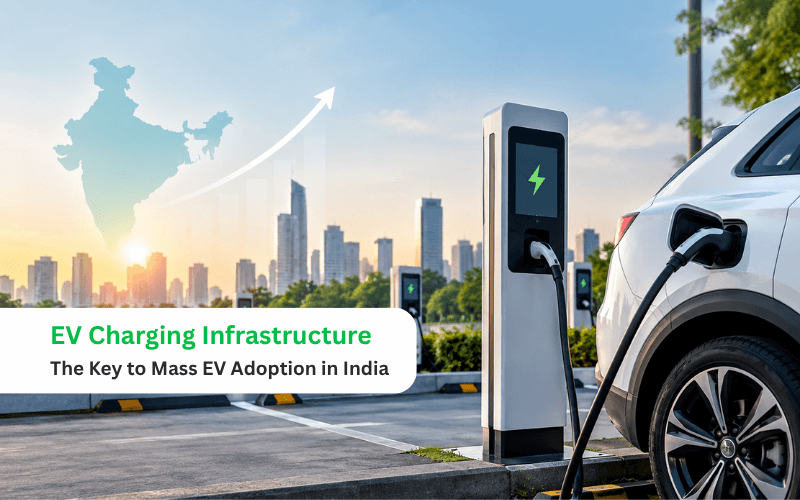
India's EV story has moved fast in the last few years from a handful of pilot vehicles on city roads to over 2.3 million electric vehicles registered in a single year. But the next phase of this journey doesn't depend on vehicles alone. It depends on whether a driver can find a working charger when they need one.
Today, India has crossed roughly 29,000 public charging stations, a nearly six-fold jump since 2022; a strong start, but still far short of what mass adoption will demand. The road ahead is about closing that gap, and building a charging network that keeps pace with India's EV ambitions through 2030 and beyond.
Why Charging Infrastructure Matters for EV Adoption
Charging infrastructure is often called the "invisible backbone" of the EV ecosystem, and for good reason. A buyer can love the economics, the performance, and the environmental benefits of an electric vehicle; but if they aren't confident they can charge it reliably, that hesitation, commonly called "range anxiety," stops the purchase decision cold.
Infrastructure availability directly shapes consumer confidence, fleet operator planning, and even real estate and urban design decisions.
India's Growth Numbers Tell A Story of Momentum, But also of A Gap Still to Close:
- Public charging stations grew from about 5,000 in 2022 to over 29,000 by December 2025; nearly a six-fold increase in three years, with more than 200 charge point operators (CPOs) now active across the country.
- A more granular count of individual chargers stood at roughly 67,600 as of August 2025, including chargers tied to battery swapping stations.
- Despite this growth, India's charger-to-EV ratio is roughly 1 charger for every 235 EVs on the road; well behind the global benchmark of 1:6 to 1:20 recommended by the IEA, and behind China (roughly 1:8) and the US (roughly 1:15).
- Karnataka leads the country with around 6,000+ public stations, followed by Maharashtra, Uttar Pradesh, and other top states that together account for nearly 78% of the national base.
- EV penetration is highest among three-wheelers (over 60%), followed by two-wheelers (nearly 9%) and four-wheelers (around 5.7%) showing where infrastructure investment is being tested first.
- Interestingly, Tier-3 and non-metro locations have begun to overtake Tier-1 cities in total charger count, signalling that EV charging is no longer just a metro-city phenomenon.
These numbers make one thing clear: India isn't short on ambition or investment appetite. It's short on the density and reliability of chargers needed to match the pace of EV sales.
Recent Policy Framework Driving the Buildout
The government has taken a structured, phased approach to closing the infrastructure gap:
Unified Bharat eCharge platform:
Announced in 2026, this initiative aims to give EV users a single digital interface to locate chargers, check availability, and make payments across different operator networks addressing one of the most common complaints from EV owners today.
State-level policies:
States like Maharashtra, Delhi, and Karnataka have layered their own incentives, tariff concessions, and mandates (such as EV-ready wiring in new buildings) on top of the central framework, creating overlapping support that has accelerated deployment in leading states.
Key Growth Drivers and Emerging Trends
Rising EV Sales are Creating Natural Demand Pull
With over 28 million total vehicle registrations in 2025 and EVs forming a growing share of that base, charging demand is compounding year over year, especially in the passenger vehicle segment where sales grew sharply.
Private Sector and Oil Marketing Companies are Scaling Fast
Companies like Tata Power, Statiq, ChargeZone, and Jio-BP Pulse are expanding aggressively, while oil marketing companies such as IndianOil, BPCL, and HPCL are converting fuel retail networks into multi-energy hubs with EV charging bays.
This growing commercial interest connects directly to the different businesses that can leverage an EV charging station model for additional revenue.
Intercity Corridor Electrification is Becoming A Priority
Routes like the Mumbai-Pune Expressway and Samruddhi Mahamarg are being developed as dedicated fast-charging corridors, addressing the long-distance travel gap that has held back four-wheeler EV adoption.
A Shift Toward Higher-Power Faster Charging
A large share of installed chargers today are still below 30 kW, but new deployments are increasingly prioritising DC fast chargers, particularly along highways and in commercial hubs, to reduce charging time and improve the ownership experience. This shift also makes it worth understanding the key differences between AC and DC charging before choosing what to deploy.
Non-Metro and Tier - 2/3 Expansion is Picking Up Pace
Charging infrastructure is no longer concentrated only in large cities; smaller towns are now seeing meaningful charger deployment, widening the addressable market for EV adoption beyond urban India.
This expansion mirrors a broader pattern; India's EV charging infrastructure growth is increasingly being driven by demand outside metro hubs.
Battery Swapping as A Complementary Charging Model
Particularly for 2-wheelers, 3-wheelers and commercial fleets, battery swapping stations are emerging as a fast, infrastructure-light alternative to traditional plug-in charging.
Conclusion: Outlook and the Road Ahead
India's EV charging network has grown fast, but the gap is still huge: hitting 30% EV penetration by 2030 will need over a million public charging points, more than 40 times what exists today. That gap is the opportunity.
For charge point operators, real estate developers, fleet businesses, and power infrastructure companies, this is the window to build networks that are reliable, well-distributed, and interoperable.
Policy is getting more coordinated, private investment is flowing in from oil companies, utilities, and EV makers, and demand keeps rising across two-wheelers, three-wheelers, and passenger vehicles.
Success in India's EV market won't be measured by vehicles sold, but by how confidently drivers can charge anywhere. That's the challenge, and the opportunity, ahead.

