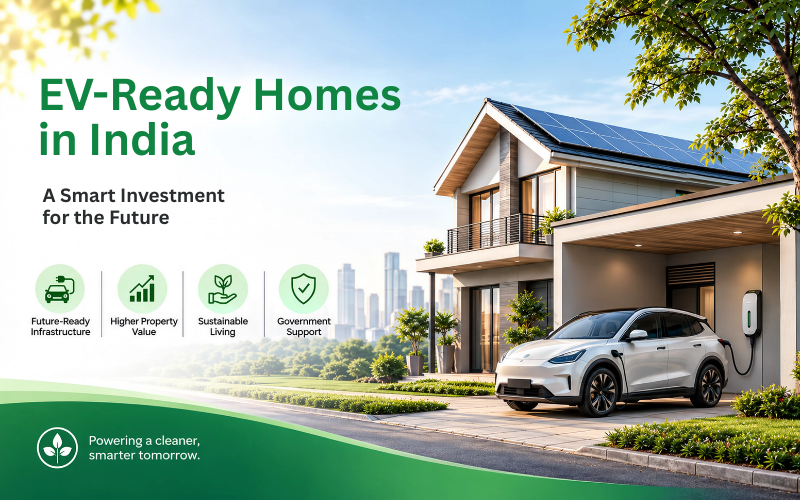
India's roads are changing fast. Every month, more electric two-wheelers, cars, and even delivery vans join the traffic. But there's a problem hiding behind this growth: most homes in India still aren't built to charge them. That's where EV-ready homes in India come in.
An EV-ready home simply means a property that already has the wiring, power capacity, and space needed to install an EV fast charger in India without a costly rework later. It's a small planning step today that saves a lot of hassle tomorrow.
If you're building a house, buying an apartment, or managing a housing society, this is worth understanding now. Future-proofing your property isn't just about convenience. It's about property value, safety, and staying ready for where India is clearly headed.
Why EV-Ready Homes Are Becoming Essential
A few years ago, electric vehicles were rare on Indian streets. That's no longer true. Two-wheelers, three-wheelers, and passenger cars are going electric across cities and even smaller towns.
Government incentives, lower running costs, and growing awareness around pollution are pushing this shift. State subsidies, reduced road tax on EVs, and central schemes have made electric vehicles more affordable than before. This momentum is part of a larger shift; India's EV market continues to see strong growth backed by global trends.
But here's the catch. Buying an EV is easy. Charging it at home often isn't.
Most Indian homes and apartment complexes were built with basic electrical setups. They weren't designed with residential EV charging in mind. So when a homeowner suddenly wants a home EV charger installed, they often run into:
- Insufficient power load at the meter
- No dedicated parking point with electrical access
- Housing society rules that haven't caught up with EV needs
This gap is exactly why EV-ready homes are becoming a real priority, not just a nice-to-have feature.
Benefits of Future-Proofing a Home
Making a home EV-ready isn't only for people who already own an electric vehicle. It's a smart move for almost anyone.
Higher property value. Homes with EV charging infrastructure already in place are more attractive to buyers and tenants. It signals that the property is modern and low-maintenance.
Lower installation costs later. Adding conduits and wiring during construction is far cheaper than breaking walls and floors after the home is finished.
Convenience. Charging overnight at home means no queue at a public charging station and no detour on the way to work.
Sustainability. Pairing a home charger with a solar powered EV charging station reduces both electricity bills and your carbon footprint.
Peace of mind. An EV-ready setup follows proper safety standards, which matters a lot when you're dealing with high-power electrical connections.
Features of an EV-Ready Home
So what actually makes a home "EV-ready"? It's not complicated. Here's what to look for or plan for:
- Dedicated electrical circuit for the charger, separate from regular home appliances
- Sufficient load capacity so the charger doesn't trip the main power supply
- A reserved parking spot with charging point access, whether in a private home or an apartment basement
- Weatherproof wiring and conduits, especially important for outdoor or semi-covered parking
- Smart metering, which lets homeowners track charging costs separately
- Compatibility with a home EV charger of different capacities, since EV models vary widely
Many new-age housing projects are also incorporating smart homes features, where the EV charger connects to an app for monitoring usage and setting charging schedules during off-peak electricity hours.
Challenges Homeowners Should Consider
Future-proofing sounds simple, but there are real challenges homeowners face in India.
Approval from housing societies. In apartment complexes, installing a charger usually needs sign-off from the resident welfare association. Rules around shared parking and common electrical load can slow things down.
Load capacity limits. Older buildings may not have the sanctioned electrical load to support multiple EV chargers, especially as more residents switch to electric vehicles.
Space constraints. Not every home has a fixed parking spot, which makes installing a dedicated charger harder in shared or open parking areas.
Upfront cost. While future-proofing saves money long-term, there's still an initial investment in wiring, safety equipment, and the charger itself.
None of these challenges are impossible to solve. They just need planning, and ideally, planning done early rather than after an EV is already parked outside with nowhere to plug in.
How Builders and Housing Societies Can Prepare
Builders and RWAs have a bigger role to play than most people realize. A few practical steps can make a real difference:
- Include EV charging infrastructure in the building's electrical design from day one, not as an afterthought
- Set aside common area load capacity specifically for EV charging infrastructure
- Mark and wire a percentage of parking spots as EV-ready during construction
- Draft clear society guidelines for charger installation, cost-sharing, and safety compliance
- Consider a solar powered EV charging station for common areas, which can support multiple residents while cutting shared electricity costs
Builders who take this step early often find it becomes a genuine selling point. Homebuyers increasingly ask about EV readiness before signing on the dotted line, especially in metro cities.
How Griden Power Supports Residential EV Charging Solutions
Griden Power works with homeowners, builders, and housing societies to make residential EV charging simple and dependable. This includes assessing electrical load requirements, planning safe wiring layouts, and recommending the right EV fast charger in India based on the vehicle types residents actually use.
For properties looking to combine sustainability with charging, Griden Power also supports solar powered EV charging station setups, helping reduce dependence on grid electricity while keeping charging costs predictable. The focus stays on practical, safety-first solutions that fit the way Indian homes and apartment complexes are actually built, not one-size-fits-all installations.
Whether it's a single home EV charger or planning EV charging infrastructure across an entire residential complex, the goal is to make the process straightforward for everyone involved.
Conclusion
The shift to electric mobility in India isn't slowing down, and homes need to keep pace. Whether you're a homeowner, a builder, or part of a housing society, planning for EV-ready homes in India today means avoiding bigger costs and bigger headaches tomorrow.
Future-proofing your property isn't just about today's electric vehicle. It's about making sure your home stays relevant, valuable, and convenient for years to come.
If you're planning a new build, renovating, or simply thinking ahead, now is the right time to start the conversation around residential EV charging. Reach out to a trusted EV charging partner and take the first step toward a truly future-ready home.

